A few months ago, I spoke with an elder in my church about something I saw coming—a problem that I felt would soon affect many Christians and one that I now see unfolding right before my eyes. Sam Shimon, a well-known Christian apologist, has gained a significant following over the years, particularly among those who appreciate his debates with Muslims. He talks to many with foul language which should not be of a born-again Christian.
Let no corrupt word proceed out of your mouth, but what is good for necessary edification, that it may impart grace to the hearers.
Ephesians 4:29
Recently, he transitioned to Catholicism, and with that shift, he began emphasising Catholic teachings, especially the Eucharist.
For those unfamiliar, the Catholic Church teaches that during the Mass, the bread and wine become the “literal” body and blood of Christ through a process called transubstantiation.
Many Catholics argue that this teaching is not only historical but biblical, citing passages like these:-
Then Jesus said to them, “Most assuredly, I say to you, unless you eat the flesh of the Son of Man and drink His blood, you have no life in you. Whoever eats My flesh and drinks My blood has eternal life, and I will raise him up at the last day. For My flesh is food indeed, and My blood is drink indeed. He who eats My flesh and drinks My blood abides in Me, and I in him. As the living Father sent Me, and I live because of the Father, so he who feeds on Me will live because of Me. This is the bread which came down from heaven—not as your fathers ate the manna, and are dead. He who eats this bread will live forever.”
John 6:53-58
For I received from the Lord that which I also delivered to you: that the Lord Jesus on the same night in which He was betrayed took bread; and when He had given thanks, He broke it and said, “Take, eat; this is My body which is broken for you; do this in remembrance of Me.” In the same manner He also took the cup after supper, saying, “This cup is the new covenant in My blood. This do, as often as you drink it, in remembrance of Me.”
For as often as you eat this bread and drink this cup, you proclaim the Lord’s death till He comes.
1 Corinthians 11:23-26
Sam’s influence in trying to lead Christians back to Rome is already having a dangerous impact. I recently heard one Christian in our church talking about early church history and how Sam Shimon’s teachings on the Eucharist made sense. If Christians aren’t knowledgeable about the Bible and don’t consider it the authoritative word of God, I can see they would start to lean toward Catholicism based on arguments that sound convincing on the surface.
The problem got worse when I searched for a strong biblical defence against Sam’s teachings or transubstantiation, but I couldn’t find much. The internet is filled with Catholic explanations of the Eucharist, but few accessible responses counter them from a biblical standpoint. That’s why I feel compelled to write this—not just as a warning but as a defence of the truth of the Lord’s Supper according to Scripture.
John 6: Do We Literally Eat Christ’s Flesh?
One of the most commonly used passages to support transubstantiation is John 6:53-58:
Unless you eat the flesh of the Son of Man and drink His blood, you have no life in you.
John 6:53
Catholics argue that this is a clear teaching that we must physically consume Christ’s body and blood to have eternal life. But is that really what Jesus meant?
First, let’s look at the context. Earlier in the chapter, Jesus says:
I am the bread of life. Whoever comes to Me shall never hunger, and whoever believes in Me shall never thirst.
John 6:35
Here, Jesus equates coming to Him with never hungering, and believing in Him with never thirsting. This shows that eating and drinking are metaphors for faith in Christ. The entire discourse is about believing in Him for eternal life—not about physically consuming Him. Let that sink in because context is important.
Furthermore, when Jesus’ disciples were confused about His words, He clarified:
It is the Spirit who gives life; the flesh profits nothing. The words that I speak to you are spirit, and they are life.”
John 6:63
If Jesus were speaking literally, why would He say “the flesh profits nothing”? He was pointing them away from a physical understanding of His words and toward a spiritual truth: that eternal life comes through faith in Him.
1 Corinthians 11: The Purpose of the Lord’s Supper
The second passage often cited to support transubstantiation is 1 Corinthians 11:23-26, where Paul recounts Jesus’ words at the Last Supper:
This is My body, which is for you; do this in remembrance of Me.
1 Corinthians 11:24
The Greek word “anamnesis” (remembrance) indicates a memorial. Catholics argue that “this is My body” should be taken literally. But Paul gives the purpose of the Lord’s Supper in verse 26:
For as often as you eat this bread and drink this cup, you proclaim the Lord’s death until He comes.
1 Corinthians 11:26
Remember, context is important, and John 6 is definitely not in context. Also consider:-
“Likewise He also took the cup after supper, saying, ‘This cup is the new covenant in My blood, which is shed for you.’”
Luke 22:20
Did you spot it? The cup represents the New Covenant—Christ’s blood (NT) instead of animal sacrifice (OT)—not the literal blood of Christ.
The Lord’s Supper is a proclamation—a remembrance of what Christ has done. Nowhere does Paul say that the elements are transformed into Christ’s actual body and blood, as Catholics believe. Instead, the act of communion is about looking back to the finished work of the cross.
This is crucial because Hebrews 10:10-14 states that Christ’s sacrifice was once for all. If the Eucharist were truly a re-presentation of Christ’s sacrifice (as Catholics believe), it would contradict the Bible’s teaching that His work was completed on the cross.
The Early Church Fathers and the Trouble with Tradition
Some early church fathers spoke of the Eucharist (which by translation means “Thanksgiving”) in profound terms, yet their views varied and did not always align with Scripture. Over time, Catholicism developed these ideas into doctrines that go beyond what the Bible teaches.
Catholics often point to early church fathers to support transubstantiation, but historical evidence is not as clear-cut as often claimed. Which church father from history do you trust? The “Early Church Fathers” sometimes made mistakes and even contradicted each other; for example, consider:
| Topic | Church Father 1 | Church Father 2 | The problem / Conflict |
| Eucharist as a Sign? | Ignatius of Antioch ~110 AD “They abstain from the Eucharist and from prayer, because they do not confess that the Eucharist is the flesh of our Savior Jesus Christ.” Letter to the Smyrnaeans, 7:1 | Augustine ~354-430 AD “If you have understood the body of Christ to be a sacrament, you have understood the truth.” Sermon 227 and “You are not to eat this body which you see, nor to drink the blood which those who crucify me will pour out. I have commended a certain sacrament unto you; understand it spiritually, and it will not consume you as the flesh.” Letter 98:9 | Ignatius may have been emphasizing Christ’s real presence in a spiritual sense rather than arguing for a literal transformation. Augustine when he says ‘sacrament’, means ‘symbolic sign‘, implying a symbolic or spiritual interpretation rather than a literal transformation. If Ignatius is literal, it conflicts with Augustine saying it’s a sign. |
| Tradition or scripture? | Irenaeus ~130–202 AD “We have learned from none others the plan of our salvation, than from those through whom the Gospel has come down to us, which they did at one time proclaim in public, and, at a later period, by the will of God, handed down to us in the Scriptures, to be the ground and pillar of our faith.“ Against Heresies, 3.1.1 | Basil of Caesarea ~330–379 AD “Of the beliefs and practices whether generally accepted or publicly enjoined which are preserved in the Church, some we possess derived from written teaching; others we have received delivered to us ‘in mystery’ by the tradition of the apostles; and both of these have the same force in relation to true religion.” On the Holy Spirit, 27:66 | Irenaeus teaches that salvation comes through the Scriptures, while Basil claims that apostolic traditions (outside of Scripture) hold the same authority. |
| How are we saved? | Cyprian of Carthage 200–258 AD “He can no longer have God for his Father, who has not the Church for his mother… unless a man be born again of water and the Holy Spirit, he cannot enter the kingdom of God.” On the Unity of the Church, 6 | Augustine 354–430 AD “God justifies the ungodly not only when they are baptized, but even before, so that, though they have not yet been regenerated by baptism, yet they are already being made new in Christ.” On the Spirit and the Letter, 27 | Irenaeus teaches that salvation comes through the Scriptures, while Basil claims apostolic traditions (outside of Scripture) hold the same authority. |
| Destiny of the Soul? | Tertullian 155–220 AD “Some suffer delay in [heaven], that they may enter in at last through the prayers of the faithful.” A Treatise on the Soul, 58 | Origen 185–253 AD “The restoration to unity must not be imagined as a sudden event, but as advancing gradually, so that all may be restored in due course… even the devil himself.” On First Principles, 1.6.1-3 | Tertullian talks of Purgatory (which isn’t even in The Bible), and Origen says everyone will make it to heaven, even the Devil! Jesus says the wicked “will go away into everlasting punishment, but the righteous into eternal life.” – Matthew 25:46 |
The problem with relying on church fathers is that while they provide historical insight, they are not infallible. Even if they were close to the Apostles, they still made mistakes, as all men do. Even Peter made mistakes. The only infallible standard we have is God’s Word.
All Scripture is given by inspiration of God, and is profitable for doctrine, for reproof, for correction, for instruction in righteousness, that the man of God may be complete, thoroughly equipped for every good work.
2 Timothy 3:16-17
Scripture is the only infallible authority. If the early church fathers contradict the Bible—or each other—then the only safe foundation is God’s Word alone.
Besides, consider that Paul was writing to an established Church in Rome (Romans 16:3-16) before Peter even set foot there, and they all knew The Gospel well (Romans 1:7). Peter didn’t establish the Church in Rome; Christ did. So you have to question… who are the ‘Early Church Fathers’ anyway? Isn’t God The Father, our Father, and Christ our Teacher, as he Himself says:-
Do not call anyone on earth your father; for One is your Father, He who is in heaven. And do not be called teachers; for One is your Teacher, the Christ.
Matthew 23:9-10
The Danger of Departing from the Simplicity of the Gospel
The real issue at stake isn’t just the Lord’s Supper—it’s the gospel itself.
Catholicism teaches that grace is imparted through the sacraments, meaning that salvation is not fully received at once but is dispensed over time. But the Bible teaches that salvation is by faith in Christ alone.
“For by grace you have been saved through faith, and that not of yourselves; it is the gift of God, not of works, lest anyone should boast.”
Ephesians 2:8-9
When people begin to shift their faith away from Scripture and toward human tradition, they risk embracing a different gospel—one that places burdens on people rather than offering the freedom that comes from trusting in Christ’s finished work.
Conclusion: Holding Fast to the Truth
If we abandon sola scriptura—Scripture alone—as our plumb line, we open the door to all sorts of theological errors. The Lord’s Supper is meant to remind us of Christ’s once-for-all sacrifice, not to repeat or re-present it.
I created this page because I see how Protestants are being influenced by Catholic teachings on the Eucharist, often without realising what they’re embracing. We must stand firm in biblical truth and not be swayed by historical traditions contradicting God’s Word. Consider what Paul said ‘The Gospel’ is:-
Moreover, brethren, I declare to you the gospel which I preached to you, which also you received and in which you stand, by which also you are saved, if you hold fast that word which I preached to you—unless you believed in vain.
For I delivered to you first of all that which I also received: that 1️⃣Christ died for our sins according to the Scriptures, and that 2️⃣He was buried, and that 3️⃣He rose again the third day 4️⃣according to the Scriptures, and that 5️⃣He was seen by Cephas, then by the twelve.
1 Corinthians 15:1-5
Do not leave the simplicity that is found in Christ. Notice there is nothing in the Gospel about doing sacraments like eating the literal flesh and drinking the literal blood of our Lord!
But I fear, lest somehow, as the serpent deceived Eve by his craftiness, so your minds may be corrupted from the simplicity that is in Christ.
2 Corinthians 11:3
Heaven and hell are real. The gospel is really simple: Christ died once for all, and by faith in Him, we are saved. The moment we start adding layers of tradition to that truth, thinking we need more than faith in His work, we risk losing the very essence of the gospel itself.
I marvel that you are turning away so soon from Him who called you in the grace of Christ, to a different gospel, which is not another; but there are some who trouble you and want to pervert the gospel of Christ.
Galatians 1:6-7
By teaching that grace is dispensed through sacraments rather than received by faith alone, Catholicism places a burden on believers that Paul warned against—adding works to the gospel and leading people away from the simplicity of Christ.
Let’s return to the pure simplicity of Scripture and hold fast to the faith once delivered to The Saints.
Don’t let tradition or religious systems replace the simplicity of faith in Christ. Test everything against God’s Word and stand firm in The Gospel of Grace. Salvation is by faith in The Gospel, and any teaching that adds requirements beyond what Scripture says must be rejected. Hold fast to the truth, and do not be deceived.
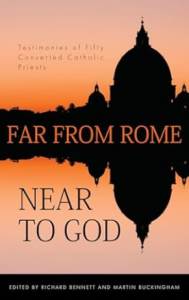
You might feel like Rome is the way to go, but many priests have realised Rome is definitely not the way to go. I can recommend this book for more insights:-